Empowering Citizen Scientists: My Microplastics Project with Ocean First Institute

Updated: Mar 31
Microplastics are everywhere: in our rivers, our tap water, and increasingly, in us. During the Spring of 2025, I had the chance to do something about it. I partnered with the Ocean First Institute (OFI), a Boulder-based ocean conservation nonprofit, to redesign their microplastics education program from the ground up — expanding its reach, lowering its barriers, and making the science more accessible to everyday people.
What Are Microplastics and Why Should You Care?

Colorado might feel far from the ocean, but it's actually a headwater state; Water that starts here flows downstream and ultimately reaches the sea. That's part of what makes OFI's work in Boulder not just meaningful, but urgent. The microplastics problem doesn't start at the coast; it starts where we live.
Why Citizen Science?
Citizen science, research carried out by everyday people, not just professionals, is one of the most powerful tools we have for understanding environmental problems at scale. When hundreds of people test their local water sources and report what they find, scientists get a map of contamination that no single research team could produce alone. It also does something less quantifiable: it makes people feel connected to the problem and empowered to be part of the solution.
OFI's microplastics outreach program has been bringing this kind of hands-on science to Colorado schools and community groups for years. The catch? Funding from the Scientific and Cultural Facilities District (SCFD) limits the program to just seven counties. Anyone curious about microplastics in their own water, but living outside those counties, was simply out of luck.
That's where I came in.
The Project
OFI brought me on through my university's ATLAS Social Impact Practicum with a clear challenge: design a way to extend the microplastics program beyond its geographic limits. My solution had to be something that could be mailed, used independently, and understood by someone without a science background.
My contributions spanned three areas:
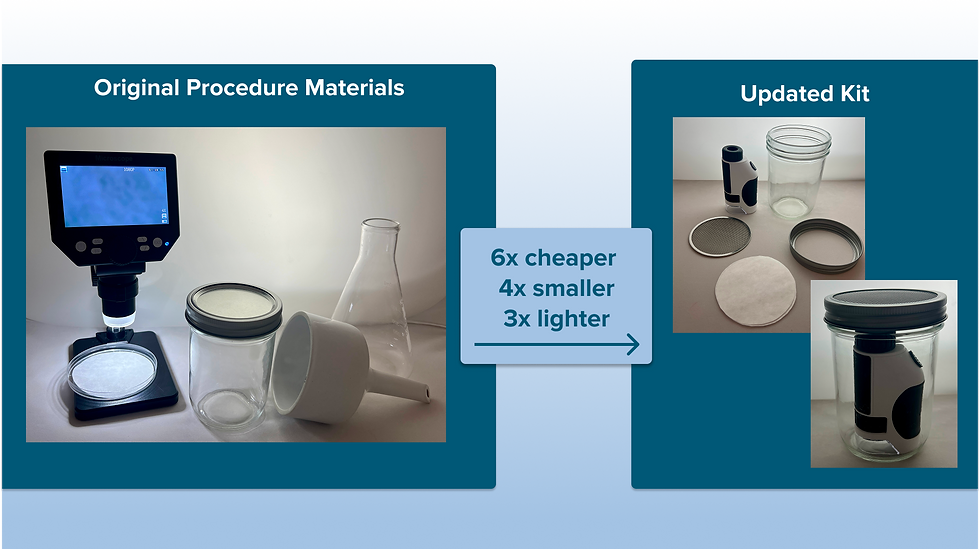
Redesigning the testing kit. The original kit relied on a ceramic Buchner funnel and glass Erlenmeyer flask, which is fragile, heavy, and highly specialized equipment. I replaced them with a jar rim and mesh disk, swapped the LCD microscope for a pocket microscope, and substituted scientific filter paper with coffee filters. The result: a kit that's six times cheaper, four times smaller, and three times lighter than the original, and it still works. Importantly, I sourced non-plastic materials throughout to align with OFI's values.
Developing new educational materials. With a redesigned protocol came the need for new instructional materials. I scoped the needs of OFI's audience and designed everything for a third-grade reading level with one step per page: clear, visual, and stress-free. My deliverables included a full lab guide and instruction packet, a classroom-friendly slide deck, and a Microplastics Identification Guide that distills complex scientific reference material into something a curious kid (or adult) can actually use. Everything was designed in Figma using OFI's brand colors, fonts, and logos.

Building a new data system. OFI had been using a citizen science platform called Anecdata that staff and participants found clunky and off-putting. I migrated the program to ArcGIS Online, creating a survey that mirrors the updated data collection form for a seamless experience. All data is now publicly accessible, and I built a live dashboard that shows the number of reports, total microplastics found, a breakdown by type, and an interactive map. Citizen scientists can see their contribution reflected in real time, which matters if you want people to actually submit their results.

I also had the chance to present this work at OFI's Microplastics Summit at the Denver Museum of Nature and Science, where I hosted a table and watched people engage with the project firsthand.
The Materials
Want a closer look? Here are the resources I created as part of this project:
Instruction Packet & Lab Guide — Full step-by-step guide for testing your water at home or in the field, including the Microplastics Identification page.
Microplastics Identification Guide — A standalone visual reference for identifying the types of microplastics you might find under a microscope.
Teaching Slides — The classroom-adapted version of the lab guide, designed for educators bringing this program into schools.
A Note on the Partnership
Working with Ocean First Institute was genuinely one of the best collaborative experiences I've had. My point of contact, a former teacher herself, was invested not just in what I was producing, but in my learning process. After reaching out to several organizations that seemed more interested in my output than my growth, that felt significant. OFI gave me the freedom to make real decisions, the support to work through challenges, and a problem worth solving.
This project was completed as part of my Master's degree curriculim in the ATLAS Institute at the University of Colorado Boulder. My area of study was in Creative Technology and Design for Social Impact. I'm happy to talk more about the design process, the materials, or citizen science in general. Feel free to reach out.


Comments